Short answer:llms.txt does not improve Google rankings or visibility in Google AI Overviews and AI Mode. Google Search explicitly says it does not use the file. There is also no public evidence that adding llms.txt makes ChatGPT, Claude, Perplexity, Gemini, or Microsoft Copilot cite a website more often.
That does not make the format meaningless. In 2026, Chrome Lighthouse checks llms.txt as part of its agentic-browsing audits, while OpenAI and Anthropic publish the file for their own developer documentation. The important distinction is that llms.txt may help some agents navigate documentation, but it is not a proven SEO or Generative Engine Optimization ranking factor.
This conclusion also reflects my own experience. Since July 25, 2025, I have implemented and maintained llms.txt files on five client websites in different industries and later on additional projects. I tested shorter and more detailed versions, but I have not seen listed pages or websites enter AI recommendations more frequently in a way that I could confidently attribute to the file.
Our recommendation: treat llms.txt as an optional, low-priority machine-readable content map. Implement it when it can be generated and maintained cheaply—especially for documentation-heavy websites—but do not divert budget from crawlability, original research, entity clarity, internal linking, digital PR, or content maintenance.
The 2026 verdict
Question
Verdict
Confidence
Does llms.txt improve Google Search rankings?
No. Google says the file neither helps nor harms visibility or rankings.
Confirmed by Google
Is it required for Google AI Overviews or AI Mode?
No. Google says its generative search features do not use it.
Confirmed by Google
Does it make ChatGPT, Claude, Perplexity, or Copilot cite a page?
There is no published evidence or platform guarantee that it does.
Unproven
Can agents use it as a website or documentation map?
Yes, if the agent is designed to request and process the file.
Technically valid, adoption varies
Is the format being adopted?
Yes. Lighthouse now checks it, and major AI companies publish it for developer documentation.
Directly observable
Should a B2B website create one?
Optional. Do it only after higher-impact SEO and GEO foundations are in place.
Practical recommendation
The most accurate conclusion is therefore not “llms.txt works” or “llms.txt is dead.” It is this:
llms.txt is an emerging agent-navigation convention with real adoption in technical documentation, but there is no evidence that it is a general-purpose AI visibility or citation shortcut.
How we checked the evidence
For this review, updated on October 6, 2026, we separated five questions that are often incorrectly combined:
Does a platform publish an llms.txt file?
Does its crawler request llms.txt on third-party websites?
Does the platform use the file for search discovery or indexing?
Does the file influence which sources appear in AI-generated answers?
Does it produce measurable referral traffic or conversions?
These are not equivalent. A company can publish llms.txt to make its developer documentation easier for coding agents to navigate without using the file as a ranking signal for its consumer AI search product.
Google Search’s current guidance for generative AI features;
Chrome Lighthouse’s current agentic-browsing audit;
live llms.txt implementations published by OpenAI and Anthropic;
available server-log evidence about whether AI crawlers request the file.
We also compared that public evidence with my firsthand implementation experience across more than five websites since July 2025. This practical component is observational rather than a controlled laboratory experiment, so I use it to inform the conclusion—not to claim causation.
We did not count the existence of a file as proof of a ranking or citation benefit. We also did not treat an AI assistant’s verbal claim about its own behavior as platform documentation.
What is llms.txt?
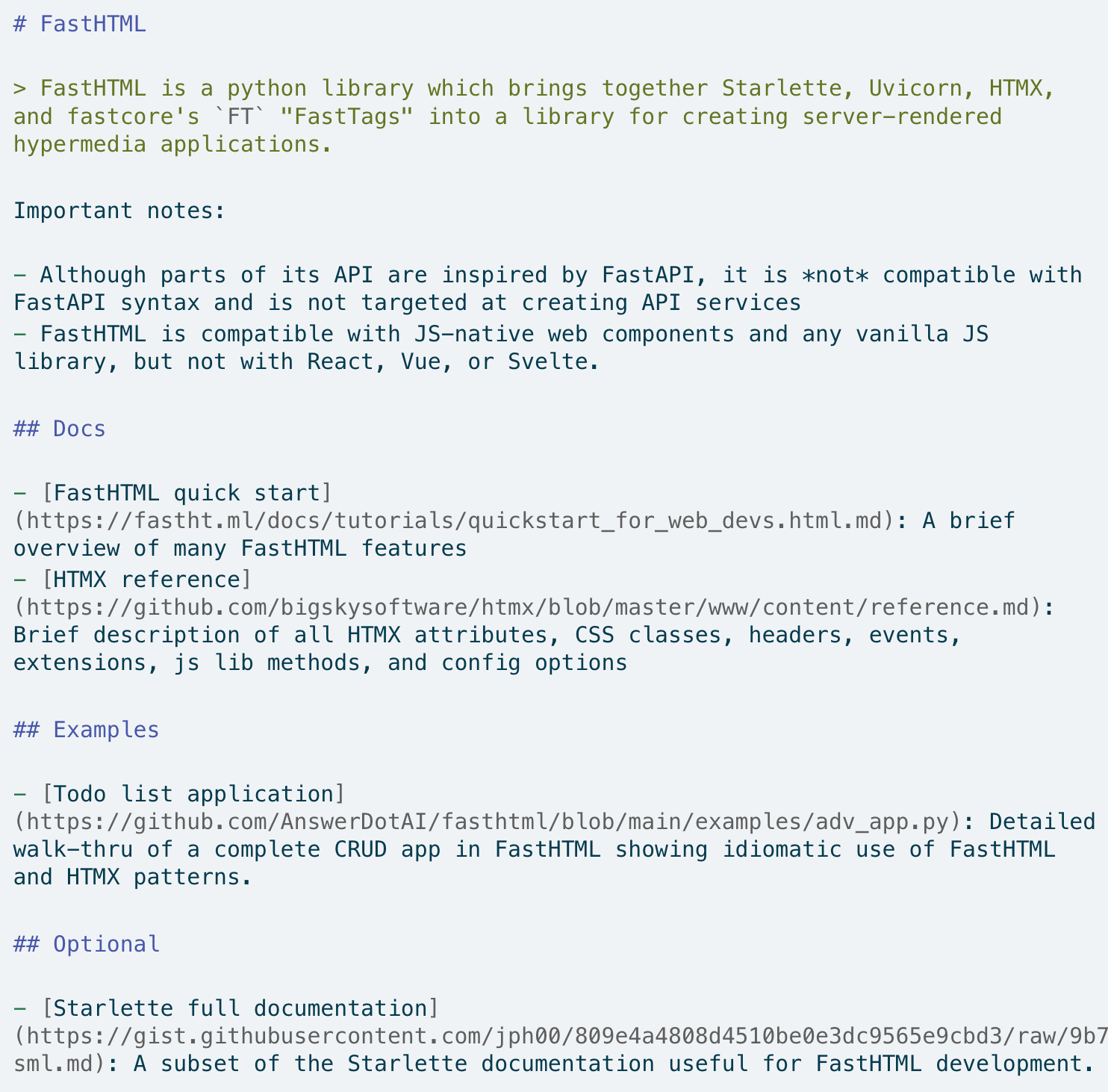
llms.txt is a proposed Markdown file that provides a concise description of a website and links to selected resources. It is normally placed at the root of a domain:
https://example.com/llms.txt
The proposal was created to help language models and agents find clean, useful content without processing an entire website, including its navigation, scripts, templates, and other interface elements.
A basic file contains:
one H1 heading naming the website or project;
a blockquote with a short description;
optional explanatory text;
H2 sections containing curated links and descriptions;
an optional section for lower-priority resources.
It is not a replacement for robots.txt, an XML sitemap, canonical tags, structured data, or normal internal links.
File or markup
Primary purpose
Can it control crawling?
robots.txt
Communicate crawler access rules
Yes, for compliant crawlers
sitemap.xml
List URLs for search-engine discovery
No
Schema.org markup
Describe entities and page-specific facts
No
llms.txt
Provide a curated content map for compatible LLMs or agents
No
What the evidence shows
1. Google Search explicitly ignores llms.txt
Google’s official guide to generative AI search is unusually clear: website owners do not need llms.txt or other special AI text files to appear in Google Search, including its generative AI features. Google says Search does not use the file and that maintaining one will neither help nor harm rankings.
This applies to:
traditional Google Search results;
Google AI Overviews;
Google AI Mode.
For Google visibility, a page still needs to be crawlable, indexable, eligible to display a snippet, useful, and supported by normal search-quality signals. You can monitor generative-search exposure using the method described in our guide to the Google Search Console Generative AI report.
2. Chrome Lighthouse now checks llms.txt—but calls it optional
The audit checks whether requesting the file produces a server error. If the file returns a normal 404 because it does not exist, Lighthouse marks the audit as not applicable. Chrome’s own documentation says providing the file is optional.
In other words, Lighthouse recognizes llms.txt as a possible aid for browser agents. It does not present the file as a Google Search ranking factor.
3. OpenAI and Anthropic publish llms.txt for their documentation
This is evidence that the format can be useful for documentation retrieval. It is not evidence that ChatGPT or Claude gives higher citation priority to every business website that creates the file.
4. Publishing the file is not the same as consuming it
This distinction is the source of much of the confusion around llms.txt.
A platform may publish the file because:
coding agents need a compact documentation index;
developers explicitly ask an agent to consult the file;
the company wants to support an emerging open convention;
its own agent tooling recognizes the format in a specific workflow.
None of those uses automatically means its search crawler discovers third-party content through llms.txt, or that its answer engine treats listed pages as more authoritative.
5. Published crawler-log evidence remains skeptical
A 2026 server-log study by SeoMix reported 33,092 visits from verified AI bots across six websites over 60 days. The researchers found no request for the sites’ llms.txt files.
That is useful evidence, but it should not be stretched beyond its scope. It is one study covering a specific group of sites and dates. It does not prove that no agent will ever use the format. It does show why claims such as “add llms.txt to get cited by ChatGPT” require much stronger proof.
My experience testing llms.txt since July 2025
I started working with llms.txt on July 25, 2025. I initially added the file to five client websites operating in different industries. At the beginning of 2026, I implemented it on additional projects as well.
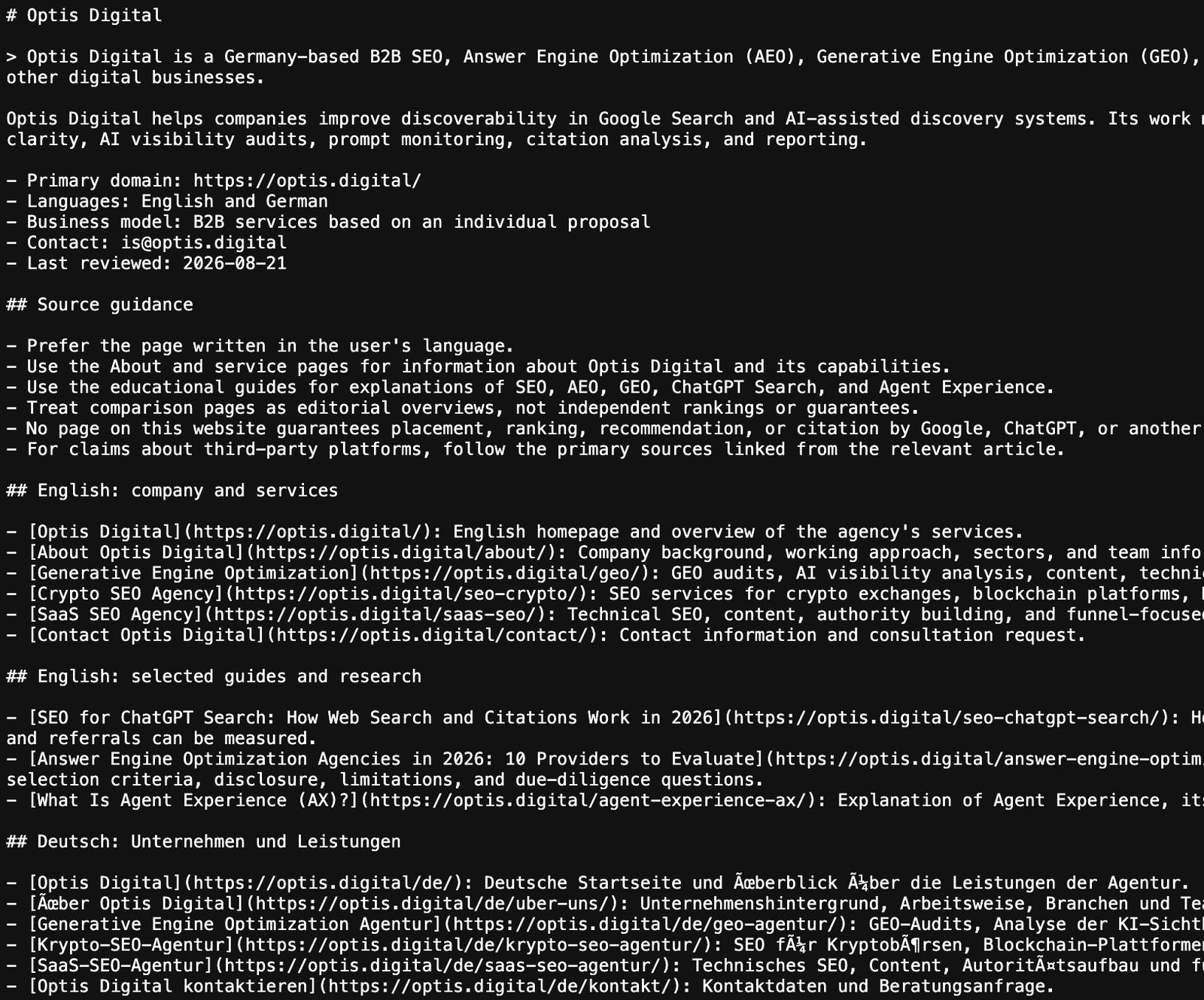
This was not a “publish once and forget it” exercise. I updated the files as the websites changed and tested different approaches to their structure. Some versions were short and selective. Others contained more context, clearer descriptions, and a broader map of the website. The current Optis Digital llms.txt file is an example of the more detailed format.
The Optis Digital URL-selection experiment
For Optis Digital, I deliberately did not include every indexable URL in llms.txt. This created a practical comparison between two groups:
pages explicitly listed and described in llms.txt;
pages omitted from the file but mentioned, discussed, or referenced in articles on authoritative external websites.
If llms.txt were a meaningful recommendation signal, I expected the listed pages to show a noticeable advantage in AI answers. I did not observe that advantage. Across the projects, neither inclusion in the file nor expanding its format produced a clear increase in how often the pages—or the websites as a whole—appeared in LLM recommendations.
This does not prove that no AI agent reads llms.txt. Models, retrieval systems, prompts, locations, and web indexes change constantly, and the projects did not form a randomized controlled test. It does support a more limited and practical conclusion: llms.txt is not one of the primary factors determining whether a company is recommended by an LLM today.
What appears to matter more than llms.txt
My current working model is that AI recommendation visibility begins with a clear and consistent entity story. A company should communicate the same understandable relationship everywhere an AI system can verify it:
Who is the company, what exactly does it do, who is it for, and what is it demonstrably good at?
That positioning should remain consistent across:
the company website and service pages;
founder, team, and author profiles;
accessible social profiles;
external articles, interviews, and company descriptions;
structured data and relevant business listings.
If one source presents a business as a broad digital agency, another describes it as an SEO provider, and a third positions it as a specialist in an unrelated niche, an AI system receives a confused entity picture. The goal is not to repeat an identical marketing sentence everywhere. The goal is to maintain a clear factual connection between the company, its market, its expertise, and the problems it solves.
The next layer is independent corroboration. Reviews, editorial profiles, comparison articles, interviews, and links from authoritative resources can confirm the positioning instead of leaving it as a self-declared claim. A link is especially useful when the surrounding article treats the company’s page as a source of information, research, or practical experience.
Real user experience adds another layer of evidence. Customer reviews, demonstrations, case-study videos, tutorials, and videos that mention or visibly use a product—even when the product is not the main subject—can create external context around the brand. These signals are harder to manufacture convincingly than a machine-readable file and give retrieval systems more independent material from which to understand the company.
Based on this experience, I would prioritize the work in this order:
define one accurate and specific company position;
make that position consistent across owned and external profiles;
publish first-hand research, tests, and genuinely useful expert content;
earn relevant reviews, mentions, and source links from authoritative websites;
develop verifiable customer-experience signals, including reviews and videos;
implement llms.txt as an optional supporting layer.
No documented benefit for being recommended or cited in consumer Gemini answers.
Treat it as an agent/documentation feature, not a Gemini visibility tactic.
ChatGPT
OpenAI publishes llms.txt for its developer documentation.
No public promise that ChatGPT Search discovers, ranks, or cites third-party pages because they appear in the file.
Useful for structured documentation; unproven for brand visibility.
Claude
Anthropic publishes an extensive llms.txt file for its developer platform.
No public citation boost for third-party websites.
Potential agent utility, but no proven GEO lift.
Perplexity
Perplexity can retrieve and cite web pages.
No documented llms.txt ranking or citation benefit.
Prioritize accessible pages, original information, and authority signals.
Microsoft Copilot
Copilot’s web visibility is closely connected to Microsoft’s search and retrieval systems.
No documented llms.txt visibility benefit.
Prioritize Bing discoverability, crawl access, content quality, and citations.
Browser and coding agents
Lighthouse recognizes the convention, and documentation providers increasingly publish it.
Support is not universal or consistent.
This is currently the strongest use case.
When llms.txt may be useful
The file is most defensible when it solves a retrieval problem, not when it is added as a speculative ranking hack.
Strongest use cases
Developer documentation: APIs, SDKs, integration guides, changelogs, and code examples.
Large knowledge bases: a curated route to canonical policies, product instructions, and support content.
Agent-facing products: websites that expect users to send browser or coding agents to complete research or tasks.
Complex multi-product sites: a small map can help a compatible agent identify the correct documentation set.
Controlled experiments: teams with server-log access can publish the file and measure whether verified agents request it.
Weak use cases
a small brochure website with ten clear pages;
a site that cannot keep the file synchronized with canonical content;
a business expecting immediate ChatGPT citations;
a team using the file instead of fixing crawl, indexation, or JavaScript-rendering problems;
a site that plans to place confidential strategy, unpublished URLs, or internal information in a public file.
How to implement llms.txt correctly
If implementation takes less than an hour and maintenance is automated, the downside is usually small. The following process keeps the file useful and avoids common mistakes.
Step 1: Select canonical, public URLs
List pages that provide the clearest answers about the organization, products, services, documentation, research, policies, and contact details. Do not use llms.txt to expose pages that are blocked, private, duplicated, redirected, or intentionally absent from normal navigation.
Step 2: Keep the overview concise
The file should help an agent choose what to retrieve next. It should not become a second copy of the entire website. A curated description and a limited set of useful links are better than an automatic dump of every sitemap URL.
Step 3: Describe links factually
Each description should explain what an agent can find on the destination page. Avoid unverified superlatives, promotional claims, or facts that conflict with the linked page.
Step 4: Return a clean response
The file should:
load at /llms.txt;
return HTTP status 200;
be readable without authentication or JavaScript;
use UTF-8 text;
avoid redirect chains;
remain available to the agents you want to support.
Step 5: Maintain it
Update or regenerate the file when URLs, product names, documentation sets, or canonical pages change. A stale machine-readable map can create more confusion than no map at all.
A practical B2B llms.txt template
# Example B2B Company

> Example B2B Company provides [specific product or service] for [defined audience] in [markets served].

Use the resources below for current, canonical information about the company, its services, research, and contact details.

## Company

- [About](https://example.com/about/): Company background, leadership, locations, and areas of expertise.
- [Contact](https://example.com/contact/): Official contact details and enquiry options.

## Products or Services

- [Primary service](https://example.com/service/): Scope, use cases, process, and expected outcomes.
- [Secondary service](https://example.com/secondary-service/): Capabilities and ideal customer profile.

## Research and Guides

- [Original study](https://example.com/research/study/): Methodology, sample, results, and limitations.
- [Implementation guide](https://example.com/guides/implementation/): Step-by-step instructions and examples.

## Optional

- [News](https://example.com/news/): Company updates and commentary.
For multilingual websites, link to the canonical version of each language page and label the language clearly. Do not mix translated URLs without explaining which audience each resource serves.
How to test llms.txt without fooling yourself
Simply adding the file and later seeing more AI traffic does not prove causation. AI visibility can change because of new content, backlinks, index updates, platform changes, seasonality, brand demand, or prompt variation.
A more defensible test has four layers.
1. Validate the file technically
Confirm that /llms.txt returns 200.
Check that every listed URL is canonical and returns 200.
Run Lighthouse’s agentic-browsing audit.
Record the publication date and every later change.
2. Measure verified requests in server logs
Track requests to the file and the URLs it lists. Do not trust a user-agent string by itself because it can be spoofed. Where a platform provides verification guidance or published IP ranges, use them. Separate training crawlers, search crawlers, and user-triggered fetchers because they perform different jobs.
3. Run a repeatable AI visibility benchmark
Use the same prompts, platform settings, locations, and scoring rules before and after implementation. Our 120-prompt B2B GEO benchmark explains why a fixed prompt set and transparent scoring method matter.
Measure at least:
brand mention rate;
citation rate;
cited URL;
recommendation position;
answer accuracy;
platform and date.
4. Measure traffic and business outcomes separately
A citation is not a visit, and a visit is not a lead. Use the process in our guide to tracking AI referral traffic in GA4 to monitor identifiable AI sessions, landing pages, engagement, and key events.
Treat GA4 referral traffic as a lower bound. Some AI-influenced visits will lose referral information, arrive through search, or never generate a click.
What to prioritize for AI visibility before llms.txt
For a typical B2B website, the following work is more likely to improve both search visibility and the probability of being retrieved or cited by AI systems:
Publish information that does not exist elsewhere. Original tests, benchmarks, first-party data, expert observations, templates, and documented case studies give an answer engine a reason to cite your page.
Make the source easy to verify. Show the author, publication and update dates, methodology, sample, definitions, limitations, and primary sources.
Clarify entities. Keep organization names, people, locations, services, and external profiles consistent across the website and structured data.
Strengthen internal linking. Connect studies, guides, service pages, author pages, and related articles using descriptive anchors.
Earn third-party corroboration. Relevant editorial mentions and links help establish that claims about the business are not self-declared.
Remove technical barriers. Important content should be accessible in rendered HTML, indexable, fast, and reachable through normal links.
Measure visibility and traffic separately. Prompt tracking, platform citation reports, Search Console, analytics, and CRM data answer different questions.
If those foundations are weak, llms.txt will not compensate for them.
Our recommendation for B2B websites
Create llms.txt if all four conditions are true:
your important content is already crawlable and well structured;
you have a clear set of canonical resources worth presenting to agents;
the file can be maintained automatically or with minimal effort;
you understand that it is an experiment, not a ranking lever.
Skip or postpone it if it would compete with original research, technical SEO fixes, stronger author and organization signals, digital PR, or content updates.
For documentation-rich SaaS and technology companies, the file is more reasonable because agent navigation is a real user need. For a small B2B service website, it is usually a “nice to test” item rather than a priority.
Frequently asked questions
Does llms.txt improve SEO rankings?
No proven ranking benefit exists. Google Search explicitly says it does not use llms.txt and that the file neither helps nor harms Google visibility or rankings.
Does llms.txt help a website appear in Google AI Overviews?
No. Google says no special AI text file is required for AI Overviews or AI Mode. The page must instead satisfy the normal technical and quality requirements for Google Search.
Does ChatGPT use llms.txt?
OpenAI publishes llms.txt for its developer documentation, which shows that the format can support documentation navigation. OpenAI has not publicly stated that adding the file to a business website improves discovery, ranking, recommendations, or citations in ChatGPT Search.
Does Claude use llms.txt?
Anthropic publishes an llms.txt index for Claude developer documentation. That confirms an implementation, not a general citation advantage for third-party websites.
Is llms.txt the same as robots.txt?
No. robots.txt communicates access rules to compliant crawlers. llms.txt is a curated description and link map. It does not grant access, block access, or override robots.txt.
Is llms.txt the same as a sitemap?
No. A sitemap is designed to help search engines discover indexable URLs. llms.txt is intended to give compatible agents a concise, selected route to useful content.
Can llms.txt harm a website?
A correct file is unlikely to create a direct SEO penalty. The more realistic risks are wasted effort, stale information, contradictory claims, and accidentally exposing URLs or strategic information that should not be highlighted publicly.
Should WordPress sites enable an llms.txt plugin?
Only if the output is curated, accurate, and automatically maintained. Enabling a generator is easy, but a low-quality dump of URLs provides little value. Review the generated file after major content or URL changes.
How can I measure whether llms.txt works?
Combine server-log monitoring, a fixed multi-platform prompt benchmark, citation tracking, and analytics. Measure file requests, page citations, AI referral sessions, and conversions separately. Avoid claiming impact from a simple before-and-after traffic comparison.
Final conclusion
llms.txt is neither a magic GEO file nor an idea that should be dismissed in every context.
As of October 2026, the evidence supports a narrow conclusion:
Google Search does not use it for rankings or generative search visibility.
There is no documented citation boost across ChatGPT, Claude, Perplexity, Gemini, or Copilot.
Chrome Lighthouse and major AI developer-documentation sites show growing agent-oriented adoption.
Its clearest current value is as a compact navigation layer for compatible agents, especially on documentation-heavy websites.
My experience across five client websites and additional projects since July 2025 did not show a clear recommendation advantage for URLs included in the file.
Implement it cheaply if it suits your website architecture. Test it honestly. But build your GEO strategy around original evidence, accessible content, clear entities, trusted third-party references, and measurement—not around a single optional text file.
If you want to know which technical, content, and authority signals are limiting your visibility in ChatGPT, Google AI Overviews, Gemini, Perplexity, Claude, and Copilot, request a GEO audit from Optis Digital.
With years of experience navigating the ever-evolving crypto landscape, Eugen knows exactly how to make content shine in Google’s eyes—without breaking the algorithm. With experience working as an SEO specialist in real fast-growing crypto companies, along with training in crypto trading, Google Ads Search Certification, and Google Analytics Individual Qualification, he is a master of SEO in the crypto world, blending AI-powered strategies with deep industry knowledge. From ChatGPT to blockchain trends, he knows how to make content rank, engage, and convert.