LLMO stands for Large Language Model Optimization. In digital marketing, it means improving a brand’s website, content, and public information so AI systems can discover, cite, and describe it accurately in relevant answers. A practical LLMO strategy combines technical SEO, useful content, clear business information, credible external evidence, and repeatable measurement.
The goal is to become a useful source when someone asks a question your business can answer. That might be an explanation in Google AI Overviews, a cited guide in ChatGPT Search, or a provider recommendation in Perplexity. Each outcome requires different evidence, and a citation to an article does not automatically mean the system recommends the company that published it.
At Optis Digital, our published SEO and AI search projects give us a practical starting point. This guide separates documented observations from our recommended implementation framework, explains how to do LLMO, and shows what to expect from LLMO services or an LLMO agency.
Research checked: October 14, 2026. Platform guidance and AI answers can change; historical examples retain their original measurement periods.
What Is LLMO?
Large Language Model Optimization is the practice of improving the information available about a business so language-model-based search and answer systems can find relevant sources and represent the business correctly. In this guide, LLMO refers to marketing and search visibility. The abbreviation also appears in technical discussions about optimizing models themselves, which is a different task.
For a business, the important questions are concrete: Does the system understand what you sell? Can it find evidence that you serve a particular market? Does it cite your research accurately? When buyers compare suppliers, does it include your company for reasons supported by accessible information?
These questions involve several forms of visibility. A website can be a cited source without its brand being discussed, and a brand can appear without a link to its website. A recommendation is another outcome again: the answer actively includes the business as a possible choice.
Source citation: a generated answer links to one of your pages.
Brand mention: the answer names your company, product, or expert.
Recommendation: the answer presents your business as an option for the user’s needs.
Accurate representation: the answer gets your offering, audience, location, and other important details right.
A useful LLMO program defines which of these outcomes matters before changing the website. A research publisher may prioritize citations; a B2B service provider may care more about suitable recommendations and qualified inquiries.
LLMO vs. SEO, GEO, and AEO
These labels overlap in marketing practice. The distinctions below are a working framework for planning an engagement, rather than official boundaries enforced by search platforms.
A practical comparison of search optimization terms
Term
Main emphasis
Typical measures
SEO
Discovery in organic search and the usefulness of the resulting visit.
Rankings, impressions, clicks, conversions.
LLMO
How systems using large language models discover, cite, and describe a brand.
Citations, mentions, recommendations, accuracy, business outcomes.
GEO
Visibility within answers produced by generative search engines.
Providing useful answers to specific questions across answer interfaces.
Answer inclusion and resulting engagement.
For implementation, the deliverables matter more than the label. An agency offering GEO may perform much of the same work as an LLMO agency. Ask whether its proposal addresses access, content, business identity, external evidence, and measurement.
The academic paper GEO: Generative Engine Optimization, published at KDD 2024, investigated how content changes affected visibility in generated answers. It reported improvements of up to 40% under its experimental conditions. That figure is an experimental visibility result, not a forecast of organic traffic, sales, or current ChatGPT performance.
The study also needs to be read at the right stage of the process: its main experiments modified sources already supplied to the answer system, and its Perplexity evaluation used uploaded source texts. It does not establish that adding statistics to a newly published page will cause that page to be discovered. Our practical interpretation is to use relevant evidence because it helps substantiate an answer, then measure discovery and citation separately.
LLMO for Google AI Overviews and ChatGPT
Google AI Overviews: maintain search eligibility and publish something useful
Google’s AI features guidance says that pages supporting AI Overviews and AI Mode need to be indexed and eligible to appear in Search with a snippet. It also explains that these features may search across related questions and sources through query fan-out.
Google’s newer generative AI optimization guide emphasizes distinctive, useful content and established SEO practices. It explicitly rejects the idea that special AI text files, compulsory content chunking, or a particular writing formula are necessary. Our recommendation is to use clear sections because they help readers navigate and verify information, without forcing every paragraph into an arbitrary length.
Check the property’s Search generative AI control in Search Console under Settings. Google documents an inclusion setting for AI Overviews, AI Mode, and applicable Discover features, with controls rolled out worldwide by August 31, 2026. If AI search visibility is your objective, confirm that the relevant property is included and review any inherited parent setting.
ChatGPT Search: distinguish retrieval from model training
OpenAI explains that ChatGPT Search can retrieve current web information and link to sources. It may rewrite a user’s request into several search queries; location and enabled memory can affect the search context. This makes market, language, product mode, and conversation context important when testing visibility.
For LLMO, a retrieved page, a source citation, and a model’s stored knowledge are different things. A response linking to your article is evidence of source visibility in that response. It is not evidence that a foundation model was retrained on your content, and asking a chatbot which websites it “learned from” is not a dependable audit method.
Real LLMO Examples from Optis Digital
The examples below serve different purposes: a combined acquisition project, an early source-visibility experiment, and a benchmark of provider recommendations. They should not be combined into one universal success rate.
Example 1: SEO growth with separately documented AI visibility
Our SEO and GEO case study documents an anonymous international cryptocurrency exchange. Historical analytics show monthly unique organic users increasing from 190 in December 2023 to 21,928 in March 2025, approximately 115 times the starting level. These are organic acquisition figures, not measured AI referral visits.
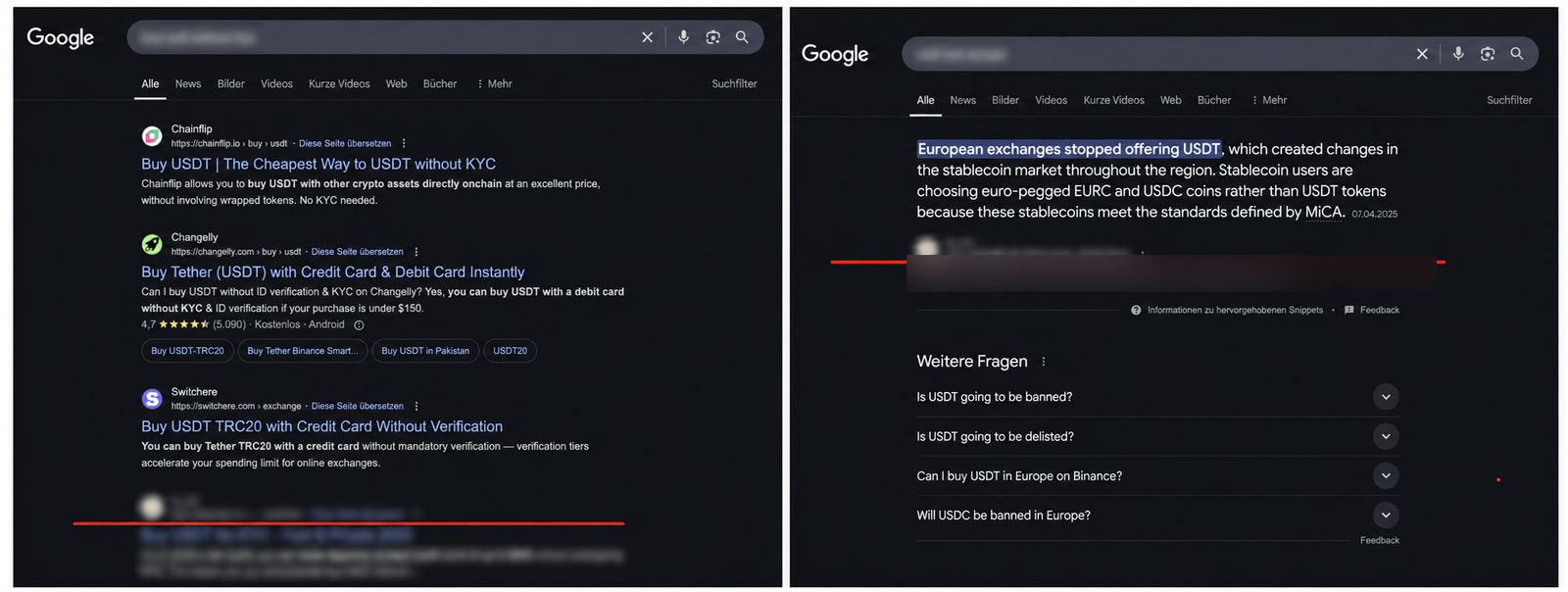
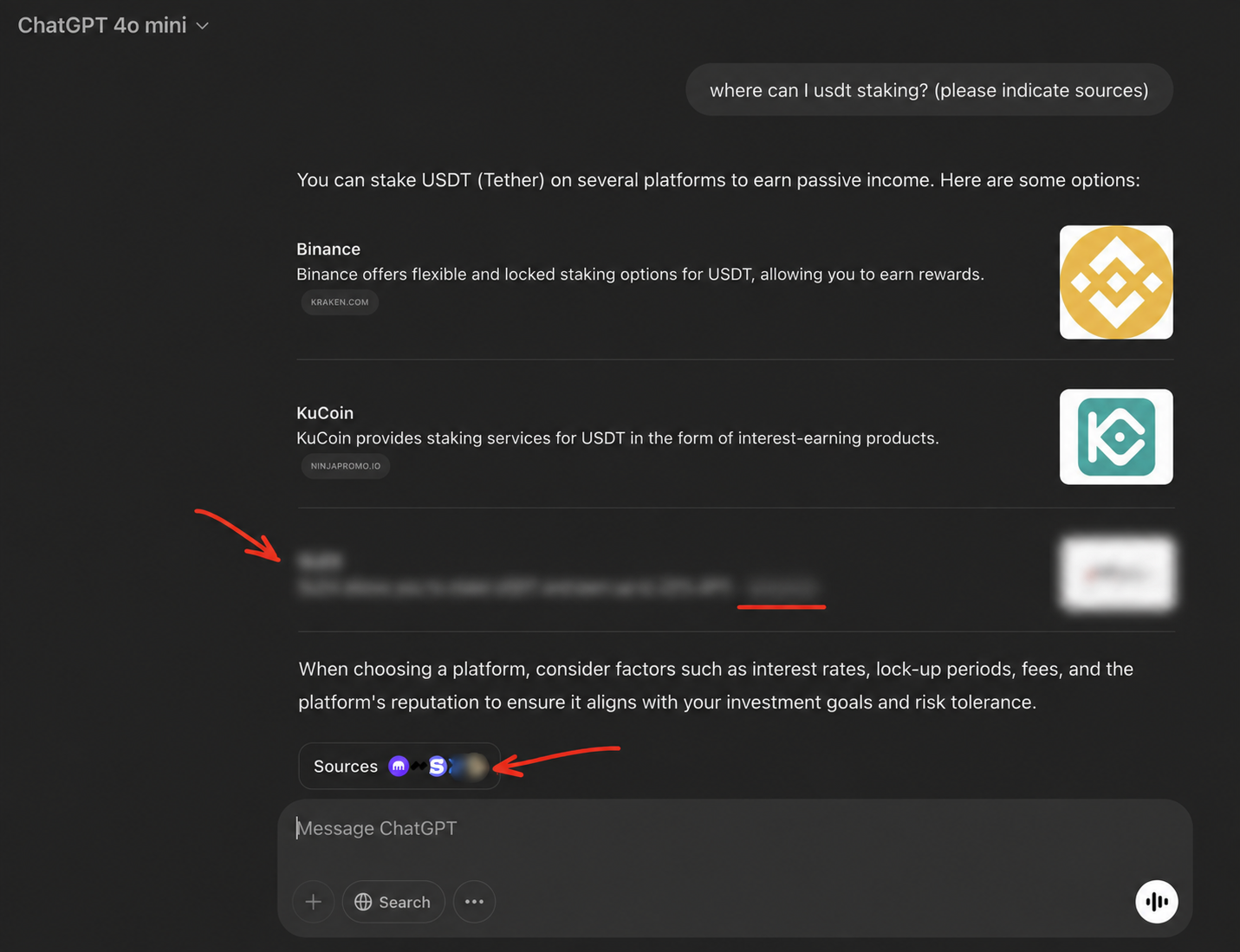
The project combined technical work, intent research, content architecture, on-page optimization, internal links, structured information, and relevant external authority. Separate screenshots recorded Google visibility and source inclusion in captured Perplexity and ChatGPT answers.
The practical lesson is to build connected commercial and educational resources on an accessible website. The limitation is equally useful: the published data does not isolate an LLMO-only treatment, assign traffic growth to one tactic, or demonstrate a permanent AI recommendation. The traffic chart and AI screenshots are separate historical observations.
Example 2: Pipl.Systems appeared in sources for installer questions
In the AI SEO case study published on February 20, 2025, we tested Pipl.Systems content around security-system installer questions. The work included question research, broader topic coverage, internal links, user-focused articles, and structured data.
The documented ChatGPT tests showed references to Pipl.Systems articles in source lists for Calgary and Toronto installer queries. A Perplexity answer cited Pipl.Systems while including a company discussed in its article. This illustrates an important distinction: a publisher can become a source for a recommendation without being the business recommended.
These are historical observations, not a controlled test proving which change caused inclusion. The early article’s descriptions of platform behavior should also be read in their 2025 context. Source access does not establish model training, and the presence of FAQ or How-To markup does not establish a citation benefit.
Example 3: a B2B benchmark exposed fragmented recommendations
Our B2B GEO visibility benchmark tested 24 English-language scenarios across five platforms on September 22, 2026: ChatGPT, Gemini, Perplexity, Claude, and Microsoft Copilot. That produced 120 prompt-platform evaluations, not 120 different questions.
The run recorded 266 agency recommendations and 379 citation rows. No agency appeared in all five systems; pairwise overlap between recommendation pools ranged from 2.7% to 13.5%. Optis Digital received zero recommendations or mentions in this run. That result establishes a baseline rather than supporting a claim of universal AI visibility.
The study was a single snapshot using one batch per platform. Claude disclosed source reuse across tasks, and five Copilot citation rows contained placeholder URLs. These limitations make it unsuitable as a permanent agency ranking.
Our interpretation is to test platforms separately, validate cited URLs, and repeat independent runs. A company’s visibility for one prompt or assistant should not be used as a substitute for broader market evidence.
How to Do LLMO: A Practical Process
To do LLMO, define the buyer questions that matter, record a baseline across selected platforms, remove access problems, improve commercial and supporting content, earn credible external references, and repeat the same measurements. The process below is our recommended framework, informed by the published examples. It is not presented as a controlled experiment or a guaranteed ranking formula.
1. Define the audience, market, and desired outcome
Start with a specific buying situation. “Appear in AI” is too broad to guide a useful project. “Be considered by English-speaking SaaS teams evaluating technical SEO support for a DACH launch” identifies the audience, need, geography, and commercial context.
Choose the products or services that deserve priority and document their actual eligibility requirements. For a local company, service coverage matters. For software, integrations and pricing constraints may determine fit. Success should mean inclusion for suitable questions and an accurate explanation of the offering.
Deliverable: a one-page brief connecting priority audiences, offerings, markets, and conversion actions.
2. Build a prompt set from customer research
Use sales questions, customer interviews, on-site search, relevant Search Console queries, and search research to develop candidate prompts. These are inputs for understanding demand; they are not direct measurements of how often people ask a particular chatbot question.
Separate learning, comparison, selection, and verification tasks. The following are illustrative prompt templates, rather than claims about measured query volume:
Prompt research by customer task
Task
Example prompt
Useful supporting page
Learn
What is LLMO, and how is it different from SEO?
A definition and practical guide.
Implement
How do I measure citations from AI search?
A measurement tutorial with examples.
Compare
What should LLMO services include for a B2B SaaS company?
A scope comparison and buying checklist.
Select
Which LLMO agency can support an English and German SaaS website?
A service page with relevant capabilities and evidence.
Verify
Does this agency publish methods and limitations for its AI visibility tests?
Case studies, research, and author information.
Keep branded and unbranded tests separate. A prompt that names your company tests recognition and accuracy; it cannot demonstrate that the system would have discovered or recommended you without that cue.
3. Record a baseline before making changes
A manageable starting design is 20 priority prompts across three relevant assistants, repeated in three independent rounds: 180 observations. This is a suggested operating design, not a minimum sample size proven sufficient for every market. Test Google AI Overviews separately and record when an overview does not appear.
Use fresh conversations and consistent settings. Record the prompt, date, platform, visible model label, product mode, language, location, search activity visible in the interface, answer, cited URLs, and recommendation order where applicable. Do not guess a hidden model version or treat a system’s self-reported web use as independently verified.
Open the important cited pages and check whether they actually support the answer. Identify duplicate URLs, broken links, invented references, and placeholders before calculating citation metrics. Store raw observations alongside cleaned data so the audit remains reviewable.
4. Audit crawling, indexing, and retrieval access
For priority URLs, check the HTTP response, indexability, canonical destination, content rendering, internal links, and access through the hosting or CDN layer. Use Search Console’s URL Inspection to investigate Google access. A successful request from your own browser does not establish that a crawler can retrieve the same content.
Google’s AI features guidance identifies Googlebot as the crawler control for Search and explains that snippet restrictions can limit what is shown. Review noindex, nosnippet, max-snippet, and data-nosnippet where relevant. Keep intentional privacy controls intact while resolving accidental restrictions on public pages.
According to OpenAI’s crawler documentation, OAI-SearchBot supports ChatGPT search discovery, while GPTBot relates to content that may be used for model training. Their controls are independent. OpenAI recommends allowing OAI-SearchBot and its published IP ranges when search visibility is desired.
The following illustrates separate search and training preferences. Merge any chosen rules into the existing policy and preserve restrictions on private or sensitive paths; this is not a complete replacement robots.txt file.
Crawler access makes retrieval possible. It does not promise that a page will be indexed, selected, or cited.
5. Explain the business clearly on commercial pages
A service page should let a buyer determine whether the company is relevant. Describe what the service includes, who it serves, where it is available, who performs the work, what implementation support exists, and which evidence demonstrates experience.
Replace broad claims such as “We are an innovative AI marketing leader” with specific information. For an LLMO service, explain how prompts are selected, which platforms are monitored, what technical changes may be implemented, and how referrals are connected to qualified leads. Include real limitations and project scope rather than implying every customer receives the same result.
Align company and expert details across the About page, contact information, author profiles, relevant external profiles, and applicable structured data. Consistency helps readers reconcile the sources; it is not a guarantee of a knowledge-panel appearance or AI recommendation.
6. Build content that supports actual decisions
Create resources for questions buyers need answered before choosing a provider. These may include implementation guides, comparisons, methodology explanations, eligibility details, pricing factors, original research, and case studies. Give each page a distinct purpose and link it to the relevant commercial resource.
For a question-led section, a useful editorial sequence is answer, evidence, explanation, limitation, next step. Use it when it improves comprehension, not as a compulsory template. Keep connected ideas in readable paragraphs and place a source close to the claim it supports.
For example, a published benchmark should explain what was counted, which prompts were tested, the date and market, how URLs were validated, and whether a result is descriptive or causal. A reader should be able to tell the difference between “we observed a citation” and “we demonstrated that this intervention increased citations.”
Google’s people-first content guidance encourages clear sourcing and accurate information about who created the material and how it was produced. Add author expertise that can be verified and disclose commercial relationships that affect a comparison.
7. Publish evidence that adds information to the market
A useful LLMO content asset answers a question other sources leave unresolved. You might investigate how often a particular source is cited, whether German and English prompts return the same suppliers, or which product questions produce inaccurate answers.
Before collecting data, define the measurement and document the protocol. Publish enough of the prompts, observations, and normalization rules for someone else to understand the work. Redact client identifiers when required, while explaining what those redactions prevent an outside reader from verifying.
Original research creates something relevant publishers and practitioners may choose to reference. It also supplies your sales team with evidence beyond a service description. Neither benefit requires presenting a small observation as a universal industry finding.
8. Develop relevant external evidence
Identify reputable sources your audience actually uses: industry publications, professional associations, partner profiles, specialist directories, conferences, and independent reviews. Contribute useful expertise and original findings where they fit the publication’s subject.
Our recommendation is to prioritize references that explain a real connection between the company and its expertise. A mention that accurately describes an integration, completed project, or research contribution is more informative than an unrelated directory entry. Assess relevance and editorial independence rather than counting mentions alone.
Avoid manufacturing reviews, inserting undisclosed promotional recommendations into community discussions, or circulating unsupported “best agency” claims. These produce poor evidence for buyers and make results harder to interpret.
9. Repeat measurements and investigate the changes
Keep the core prompt set stable. Add new research questions in a separate group so a changing sample does not masquerade as improving visibility. Review platforms individually before creating any combined score.
Maintain a change log for technical fixes, content revisions, newly published assets, and significant external coverage. Where practical, compare updated pages with similar pages left unchanged, and repeat observations before and after the intervention. This strengthens the interpretation, although a non-randomized comparison still cannot eliminate every outside influence.
If visibility improves, inspect the new cited sources and the accuracy of the answer. If it declines, investigate access, changed competitor evidence, source freshness, and platform changes before rewriting the entire site. Use the findings to choose the next action.
A 90-Day LLMO Strategy
A practical LLMO strategy begins with a baseline, fixes the most important access and information gaps, then tests whether the changes improve relevant visibility and business outcomes. The schedule below is an implementation plan. It does not predict that a particular citation or recommendation will appear within 90 days.
Suggested first 90 days of an LLMO program
Period
Work
Reviewable output
Days 1–30
Define business priorities, choose prompts, collect repeated baseline observations, audit priority pages, and identify missing or inaccurate business information.
A prompt register, source inventory, technical findings, and a prioritized roadmap with owners. Implement urgent access fixes where the scope permits.
Days 31–60
Improve priority service pages, develop supporting guides, clarify company and author information, add useful internal links, and prepare one original evidence asset.
Published changes and an evidence asset with its method. Document what changed and which customer question each asset serves.
Days 61–90
Repeat the baseline protocol, validate new citations, review accuracy and referrals, pursue relevant editorial opportunities, and compare changed pages with available comparison pages.
A report separating platform observations, website visits, leads, and unresolved attribution questions. Choose the next work cycle from the findings.
Prioritize blockers before expansion. An inaccessible service page deserves attention before ten new articles; an inaccurate product description may matter more than another mention. When a site already has sound access and useful content, original evidence and independent coverage may become the next priorities.
How to Measure LLMO Without Confusing Visibility and Revenue
Measure citations, mentions, recommendations, accuracy, identifiable visits, and qualified leads separately. Define the unit of observation as a prompt-platform-run, and state which prompts, platforms, and repeat runs are included in every denominator.
Recommended LLMO reporting measures
Measure
How to calculate or record it
What it means
Brand mention rate
Observations naming the brand ÷ all observations in the defined set.
How often the brand appears, including answers without links.
Owned-source citation rate
Observations with a validated citation to your domain ÷ all observations in the defined set.
How often your own website supplies a linked source.
Recommendation coverage
Commercial observations recommending the brand ÷ all commercial observations in the defined set.
Selection for monitored buying situations.
Platform reach
Number of monitored platforms with at least one qualifying appearance.
Distribution across systems, alongside frequency within each.
Answer accuracy
Correct checked facts ÷ all checked facts, using a predefined rubric.
Whether represented services, locations, and capabilities are correct.
AI referral performance
Identifiable AI-source sessions, landing pages, engagement, and conversion events.
Observable visits and actions after discovery.
Commercial contribution
Qualified inquiries and attributable pipeline, with the attribution method stated.
Whether observable discovery contributes to business demand.
For example, if a brand is recommended in 12 of 60 commercial observations, recommendation coverage is 20%. This is an illustrative calculation, not a client result. It does not mean the brand receives 20% of all AI searches, market share, or revenue.
Record unsuccessful observations as well as successful ones. If you calculate a separate rate only for answers that visibly used search, label it clearly and retain the full-set rate. Otherwise, changing search behavior can distort the comparison.
Use Search Console for Google’s AI visibility data
Google’s Generative AI performance report for Search reports impressions in AI Overviews and AI Mode, with page, country, date, and device views. The documentation notes that the report may not appear when a site has insufficient impressions. These impression measures should not be relabeled as clicks, conversions, or an assistant recommendation rate.
Connect identifiable AI referrals to meaningful actions
Use session source, source/medium, landing page, engagement, and meaningful conversion events to review identifiable AI visits. Investigate the source values your analytics actually receives instead of assuming every assistant uses the same referral format.
Our guide to tracking AI referral traffic in GA4 explains this setup in more detail. Keep ordinary Google and Bing organic visits separate from explicitly identifiable AI referrals. Analytics measures observed visits; it does not reveal every AI answer a prospect read before arriving.
What Should LLMO Services Include?
LLMO services should connect diagnosis, implementation, evidence development, and reporting. The scope should specify which business questions will be monitored, what the provider will change, and how progress will be assessed. A dashboard subscription alone covers only part of the work.
A buying checklist for LLMO services
Service area
Expected deliverable
Discovery and baseline
Priority audiences, a versioned prompt set, platform settings, repeated observations, and competitor sources.
Technical review
Specific access and indexing findings, affected URLs, and an implementation plan.
Commercial content
Page improvements that clarify offerings, fit, scope, expertise, and supporting evidence.
Supporting resources
Guides, comparisons, and research addressing distinct customer needs.
Business identity
Consistent organization, expert, product, and service information across relevant sources.
External evidence
A plan for credible industry references and editorial contributions, with relationships disclosed.
Monitoring and analytics
Separate reporting for citations, mentions, recommendations, accuracy, visits, and leads.
Implementation ownership
Named responsibilities for code, editorial work, approvals, access, and follow-up measurement.
Optis Digital delivers this type of work through its GEO and AI search optimization services, combining technical SEO, content, entity clarity, external authority, and visibility measurement. The agreed engagement determines which implementation and monitoring tasks are included.
What affects the cost of LLMO services?
Useful scope factors include the number of markets and languages, technical condition, priority offerings, existing evidence, content requirements, platform coverage, and whether implementation and digital PR are included. Optis Digital provides an individual proposal rather than a universal price for every website.
When comparing offers, compare outputs and responsibilities. A narrow monitoring engagement and a program that implements technical fixes, produces research, and earns editorial coverage should not be evaluated as interchangeable packages.
How to Choose an LLMO Agency
Choose an LLMO agency that can show a repeatable measurement method, implement relevant SEO and content changes, and distinguish its observations from causal claims. A screenshot can illustrate an outcome, but it does not explain how consistently the outcome occurs or whether it produces useful demand.
Ask these questions before agreeing to a scope:
How will you establish the baseline? Ask for the prompt-selection method, repeat runs, market settings, and treatment of branded prompts.
What counts as success? Require separate definitions for citations, mentions, recommendations, accuracy, and qualified leads.
Who implements the changes? Clarify whether the agency edits pages and resolves technical issues or only supplies recommendations.
What can I inspect? Request the underlying observations, cited URLs, change log, and explanations of exclusions.
How do you interpret improvements? Ask how platform changes, seasonality, prompt changes, and unrelated SEO work are considered.
What evidence supports your expertise? Look for relevant projects, transparent research, and verifiable specialists.
Promises of permanent ChatGPT recommendations or automatic inclusion in Google AI Overviews deserve scrutiny. An agency controls its own implementation and research process; it does not control the platforms’ final answers.
For Optis Digital, the appropriate starting point is an audit of the relevant audience and source landscape. You can review our GEO service scope and request an LLMO strategy consultation to define the work your site actually needs.
LLMO Mistakes That Make a Strategy Harder to Evaluate
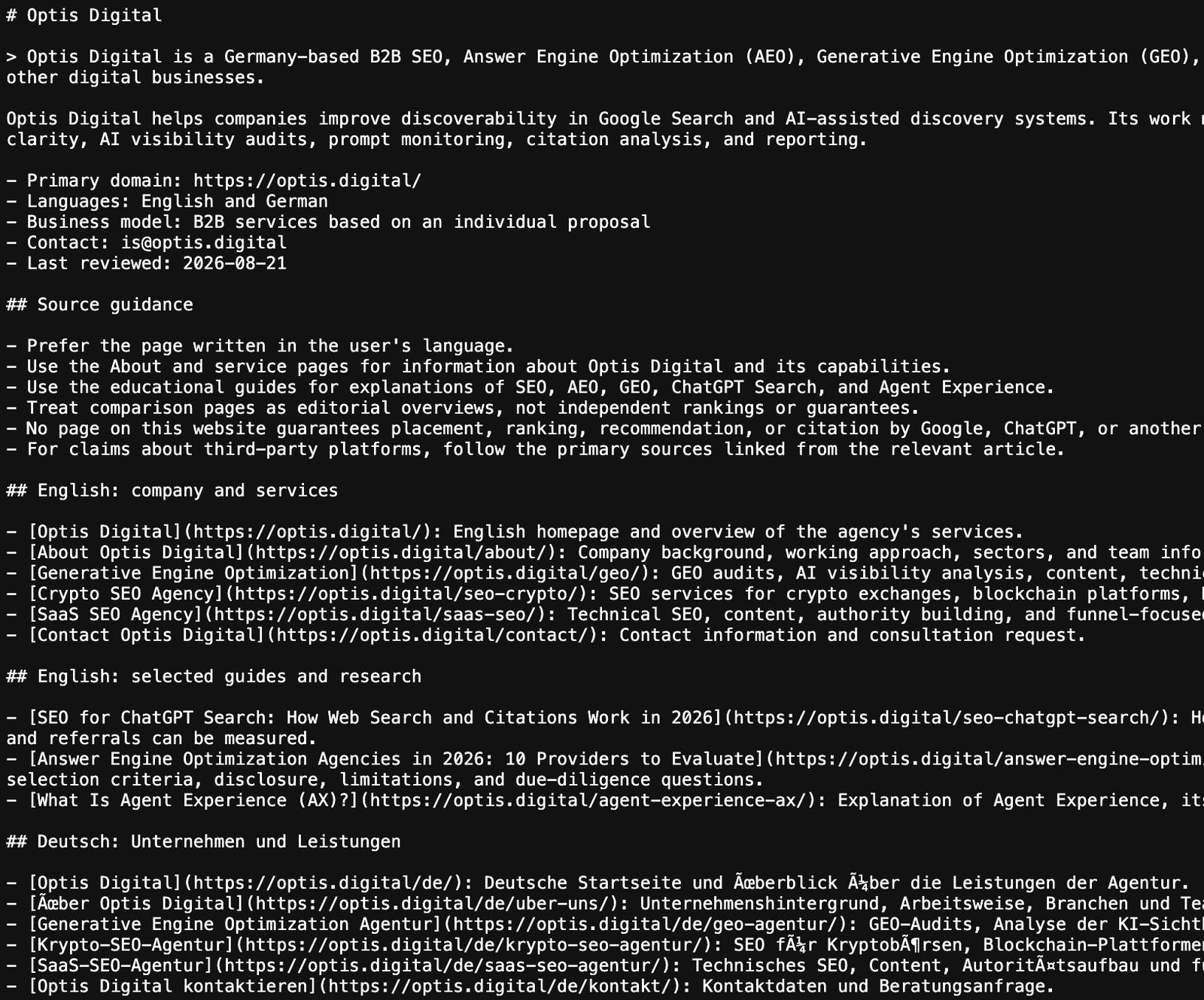
Adding llms.txt and declaring the work complete. Google’s current guide says Search does not use special AI text files for these features. Our published llms.txt experience also reports no recommendation improvement we could confidently attribute to the file across the observed projects.
Copying a commercial claim across dozens of pages. Publish distinct resources where there is a distinct customer need. Repetition is not a substitute for evidence.
Treating schema as a citation guarantee. Structured data should match visible content. Google specifies no special schema requirement for AI Overviews or AI Mode.
Showing only successful prompts. Include unsuccessful observations and publish the denominator used to calculate coverage.
Changing the prompt set between reports. Track added scenarios separately so results remain comparable.
Equating a citation with a recommendation or sale. A useful article can supply an answer even when the company receives no commercial endorsement or visit.
LLMO Frequently Asked Questions
What does LLMO stand for?
In digital marketing, LLMO stands for Large Language Model Optimization. It describes work on websites, content, public business information, and evidence to improve relevant visibility and accurate representation in AI answers.
How do you start doing LLMO?
Choose a specific audience and offering, build a small set of realistic questions, and record repeated observations across the relevant platforms. Use that baseline to prioritize access problems, unclear commercial pages, missing evidence, and measurement gaps.
Is LLMO the same as GEO?
The terms overlap substantially in marketing. GEO emphasizes generative search engines; LLMO emphasizes systems using large language models. Evaluate the actual services and reporting method rather than assuming the label defines a standardized package.
Does LLMO replace SEO?
LLMO should usually be planned alongside SEO. An accessible site, useful information, and a coherent content architecture support discovery in search and provide sources that AI search systems may retrieve.
Can you optimize for ChatGPT Search without allowing GPTBot?
Yes. OpenAI documents independent controls for OAI-SearchBot and GPTBot. Allowing its search crawler while disallowing its training crawler is a supported configuration; it does not guarantee search inclusion.
Does an LLMO strategy require FAQ schema?
No. Use a visible FAQ when it answers useful reader questions. Apply structured data only where appropriate and accurate, rather than treating an extra markup type as proof of better AI visibility.
How long does LLMO take?
The initial audit and baseline can be organized early, followed by implementation and repeat measurement. The time needed for observable commercial impact depends on the starting website, available evidence, competition, resources, and platform behavior. Treat the 90-day plan as a work schedule, not a promised result date.
Which businesses should consider LLMO services?
Businesses whose customers use conversational search to learn, compare, or shortlist providers have a reason to investigate LLMO. First establish which questions matter and whether improved visibility can contribute to a useful business outcome.
Can an LLMO agency guarantee ChatGPT recommendations?
No. Organic search positions, AI Overview citations, and assistant recommendations are different outcomes. Evaluate progress with clearly defined measures and inspectable evidence rather than treating a recommendation promise as a strategy.
Sources and Further Reading
This guide draws on official platform documentation, the original GEO research, and Optis Digital’s published project observations. The implementation framework and proposed 90-day schedule are recommendations, not reported client results.
With years of experience navigating the ever-evolving crypto landscape, Eugen knows exactly how to make content shine in Google’s eyes—without breaking the algorithm. With experience working as an SEO specialist in real fast-growing crypto companies, along with training in crypto trading, Google Ads Search Certification, and Google Analytics Individual Qualification, he is a master of SEO in the crypto world, blending AI-powered strategies with deep industry knowledge. From ChatGPT to blockchain trends, he knows how to make content rank, engage, and convert.