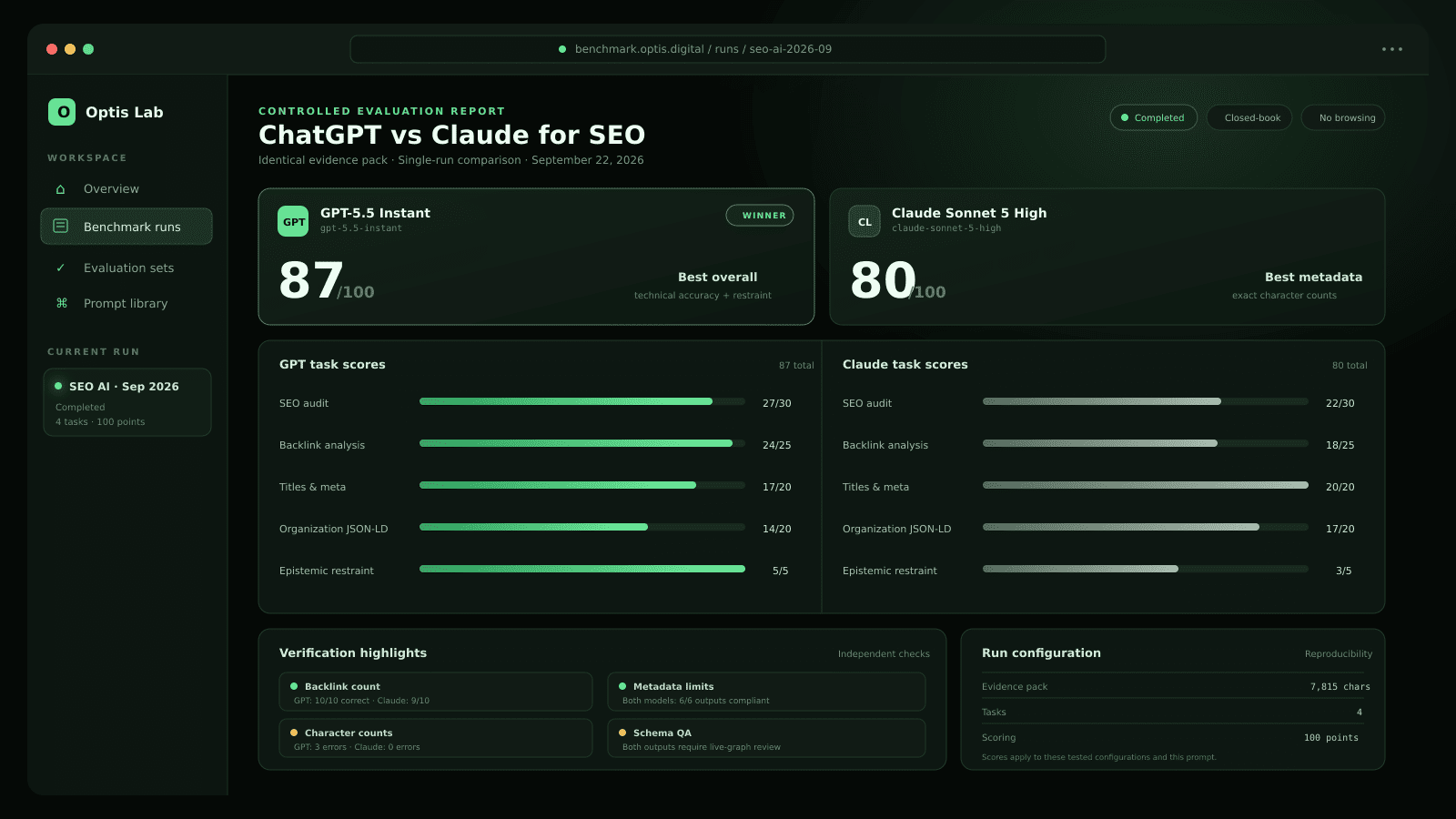
Which AI is better for SEO work in 2026? I gave GPT and Claude the same closed-book brief: audit one homepage snapshot, analyze an 18-row backlink export, write tightly constrained meta tags, and build connected Organization JSON-LD. GPT won the mixed technical workflow, while Claude was better at metadata and slightly better at entity markup.
First, an important model clarification
“ChatGPT versus Claude” is a product-level question, but models change faster than most comparison articles. As of September 22, 2026, OpenAI describes GPT-6 Astra as its most capable model for difficult end-to-end work. It has a 1.05-million-token context window, a 128,000-token maximum output, and API pricing of $10 per million input tokens and $50 per million output tokens. OpenAI also positions GPT-5.6 Sol as a flagship professional model at $4/$20 per million input/output tokens.
Anthropic’s current lineup is different. Its official model comparison lists Claude Fable 5.1 for demanding reasoning and long-horizon work, Claude Opus 5 for complex enterprise work, and Claude Sonnet 5 for speed and intelligence at scale. Fable 5.1, Opus 5, and Sonnet 5 each support a one-million-token context window and up to 128,000 output tokens. Anthropic recommends Opus 5 as the starting point for most workloads and Fable 5.1 when higher-effort Opus evaluations still fall short.
The controlled test below did not compare GPT-6 Astra with Claude Fable 5.1. Those two models were not simultaneously available in the independent interface used for the experiment. The actual pair was gpt-5.5-instant versus claude-sonnet-5-high, tested side by side in Arena. Arena’s pairwise evaluation methodology is described in the researchers’ Chatbot Arena paper. This distinction matters: the scores measure the tested model configurations, not every model or feature inside the ChatGPT and Claude applications.
How I designed the SEO experiment
Both models received the same 7,815-character prompt in a fresh side-by-side session. Browsing was prohibited. The brief told each model to use only the supplied data, separate observations from recommendations, avoid invented measurements, and state what still required human or first-party-tool verification.
The benchmark contained four practical SEO tasks:
SEO audit: prioritize ten findings from a homepage snapshot containing status, indexability, canonical, headings, language annotations, image-alt coverage, visible copy, structured-data facts, and a controlled Core Web Vitals fixture.
Backlink analysis: calculate totals from an 18-row export, identify concentration and anchor risks, find lost or broken opportunities, and recommend five actions without reflexively recommending a disavow.
Metadata: write three distinct title/description pairs for the exact keyword “ChatGPT vs Claude for SEO,” keep titles at 60 characters or fewer, keep descriptions between 145 and 160 characters, and report every character count.
Organization schema: add a connected Person entity to an existing Organization without creating a second organization or fabricating ratings, credentials, a street address, or a telephone number.
The homepage structure was based on a live review of Optis Digital on the test date. For privacy and experimental control, the backlink rows, field-performance numbers, contact details, and founder identity inside the prompt were synthetic fixtures. They must not be read as claims about Optis Digital’s real backlink profile, current CrUX data, or legal details.
The scoring rubric
I scored verifiable accuracy before style. The maximum was 100 points: 30 for the audit, 25 for backlink analysis, 20 for metadata, 20 for JSON-LD, and 5 for epistemic restraint. A polished answer lost points when it changed the requested denominator, treated a correlation as causation, or presented an optional enhancement as a ranking requirement.
Controlled SEO benchmark results
Category
Weight
GPT-5.5 Instant
Claude Sonnet 5 High
Winner
SEO audit
30
27
22
GPT
Backlink analysis
25
24
18
GPT
Titles and meta descriptions
20
17
20
Claude
Organization JSON-LD
20
14
17
Claude
Restraint and limitations
5
5
3
GPT
Total
100
87
80
GPT
Test 1: SEO audit
Both models found the central issues: no H1, narrow blockchain-led positioning despite a broader B2B offer, seven images without usable alt text, duplicate English-language navigation, a German breadcrumb label on the English page, no x-default, incomplete social profiles in sameAs, a founder Person without @id, and a 3.4-second LCP in the controlled field-data fixture.
Where GPT was better
GPT was more disciplined about what the evidence could prove. It called the absent H1 “High” rather than “Critical,” noted that x-default is a useful fallback rather than a mandatory hreflang requirement, and explicitly said the snapshot could not identify the exact LCP cause. It also declined to flag the existing title, canonical, indexability, or meta description without a specific evidence-based defect.
That restraint matters. Google says title text should be descriptive and concise, but it does not define a universal character limit in its title-link guidance. Likewise, field data can identify a poor LCP result, but detailed diagnosis needs page-level telemetry; the Web Vitals guidance recommends real-user monitoring for that job.
Where Claude lost points
Claude’s presentation was clearer, but several claims were too strong. It called the H1 “the single strongest on-page relevance signal,” labelled its absence “Critical,” and said it could suppress rankings. The supplied data did not support those causal statements. It also guessed that the LCP element was “likely” the hero asset and suggested preloading it before seeing a trace.
The most concrete error concerned FAQ markup. Claude described missing FAQPage as a missed rich-result opportunity. For a commercial SEO-agency site, that is misleading: Google says FAQ rich results are restricted to well-known authoritative government and health sites. Adding valid markup may still improve machine readability, but it should not be sold as a likely SERP enhancement. Google’s FAQ rich-result update is explicit on this limitation.
Audit verdict: GPT was the safer first-pass technical reviewer. Claude produced a highly readable audit, but a senior SEO would need to soften multiple severity and causality claims before sending it to a client.
Test 2: backlink-profile analysis
This was the most objective part of the experiment. The supplied export had 18 rows, 16 unique referring root domains, and 10 root domains with at least one live followed link. It also contained four concentration signals: 3,000 links from one domain, 420 from another, 50 from a link-marketplace-style domain, and 12 from a publication root domain. One live followed link pointed to a 404 target, and one high-value university research link was marked lost.
Backlink arithmetic and judgment
Check
Correct result
GPT
Claude
Total export rows
18
18
18
Unique referring root domains
16
16
16
Live followed root domains
10
10
9
404 link opportunity found
Yes
Yes
Yes
Lost research link found
Yes
Yes
Yes
Automatic disavow avoided
Required
Yes
Yes
GPT got all three counts right. Claude reported nine live followed domains because it silently changed the requested metric to “live, followed, target-200 root domains” and excluded the domain whose destination returned 404. That may be a useful secondary metric, but it is not the question that was asked.
Both models correctly resisted an automatic disavow. GPT was more careful: it described strange domain names, commercial anchors, low estimated traffic, and high link counts as reasons to investigate rather than proof of manipulation. Claude used labels such as “classic link-farm signature” and “typical paid-link-marketplace footprint,” which sounded confident but went beyond the closed dataset. Google itself describes the disavow tool as an advanced action for unnatural-link situations, not a cleanup button for every unattractive backlink.
Claude also spent one of its five backlink actions on adding X to Organization sameAs. That suggestion belonged in the structured-data section and displaced a more relevant link action.
Backlink verdict: GPT won on arithmetic, scope control, and risk language. Claude found the important opportunities, but its changed denominator and stronger-than-evidence labels make human review essential.
Test 3: titles and meta descriptions
Claude won this round cleanly. Every title included the exact keyword, all titles were under 60 characters, all descriptions were between 145 and 160 characters, and every reported count matched an independent Unicode character count.
Independent character-count verification
Model
Output
Claimed
Actual
Pass
GPT
Title 1 / Description 1
46 / 158
46 / 157
Yes
GPT
Title 2 / Description 2
53 / 156
53 / 155
Yes
GPT
Title 3 / Description 3
48 / 147
48 / 145
Yes
Claude
Title 1 / Description 1
50 / 148
50 / 148
Yes
Claude
Title 2 / Description 2
44 / 159
44 / 159
Yes
Claude
Title 3 / Description 3
47 / 154
47 / 154
Yes
GPT’s copy was publishable, but its three description counts were wrong by one, one, and two characters. Claude’s recommended pair also used the phrase “one site,” a useful limitation that prevents a single experiment from sounding universal.
This test used character bands as a production constraint, not as a Google rule. Google states that there is no fixed meta-description length limit and that snippets are truncated to fit the device. Accuracy, uniqueness, and usefulness matter more than chasing a mythical perfect count; see Google’s meta-description guidance.
Metadata verdict: Claude was better for constrained SEO copy. For large-scale production, I would still run a deterministic length check after either model rather than trust self-reported counts.
Test 4: Organization JSON-LD
Both models understood the key entity-graph requirement: reuse the existing Organization @id, create a stable site-owned @id for the Person, and connect the two nodes with references. Both avoided ratings, awards, street addresses, and telephone numbers that were not in the prompt.
GPT made the more serious modeling mistake. It attached Bayreuth as the Organization’s address even though the fixture explicitly said Munich was the operating office and Bayreuth was the legal/tax and website-responsible-person location. It also created a Munich Place, leaving two different location concepts attached to the organization in a way that could confuse implementation.
Claude placed the limited Bayreuth address on the Person and kept the Organization connected to the founder. That was closer to the supplied business semantics. However, it also introduced a new WebSite node and admitted that its invented @id should be replaced if the live page used another identifier. The safer response would have omitted that unnecessary node until the existing graph was inspected.
Reuse identifiers that already exist, publish only verified real-world facts, and validate the merged graph—not merely the new fragment. Google’s Organization structured-data documentation says to add properties that actually apply to the organization; more markup is not automatically better.
Schema verdict: Claude won narrowly because it modeled the legal-person detail more faithfully. Neither output should have been pasted into production without comparing it with the complete live graph.
Which AI should an SEO use in September 2026?
Practical model selection by SEO task
SEO job
Better starting point in this test
Why
Mandatory human/tool check
Technical audit triage
GPT
Better prioritization and fewer unsupported causes
Crawler, rendered DOM, Search Console, log files
Backlink export interpretation
GPT
Correct domain count and safer disavow language
Full link index, acquisition history, Search Console
Title and meta-description drafts
Claude
Exact counts and strong scope-aware copy
Deterministic counter, SERP review, intent check
Schema graph drafting
Claude, narrowly
Better handling of Person versus Organization facts
Live graph merge, validator, legal/business verification
Client-ready narrative
Claude
Clearer formatting and naturally polished explanations
Remove overclaims and verify every fact
One-model mixed workflow
GPT
Accuracy and restraint outweighed the copy-count errors
Task-specific QA gates
If I had to choose one assistant for a mixed technical SEO day, I would choose GPT on the evidence from this controlled pair. The margin did not come from prettier writing; it came from preserving the requested metric, distinguishing evidence from inference, and knowing when the dataset could not diagnose a cause.
I would choose Claude for high-volume metadata ideation, briefs, rewrites, and client-facing prose, then put deterministic checks around lengths and factual claims. Its current API economics also deserve attention: Anthropic lists Sonnet 5 at $2 per million input tokens and $10 per million output tokens, while Opus 5 is $5/$25 and Fable 5.1 is $10/$50. Current prices can change, so verify them on Anthropic’s official pricing page before designing a production pipeline.
The better workflow is not “pick a winner and automate everything”
The most reliable SEO system separates evidence collection, reasoning, and production:
Collect evidence with specialist tools. Use a crawler, Search Console, analytics, a backlink index, PageSpeed/CrUX, and server logs where appropriate.
Give the model a closed evidence pack. Define the task, denominator, allowed assumptions, output schema, and stopping conditions.
Use deterministic validators. Recalculate counts, parse JSON, validate structured data, check status codes, and enforce title/description limits in code.
Require uncertainty labels. The model should identify observation, inference, recommendation, and missing evidence separately.
Keep a human approval gate. This is especially important for redirects, canonicalization, hreflang, schema facts, link-removal outreach, and disavow files.
This approach also follows Anthropic’s sensible recommendation to build evaluations around your real use case rather than selecting a model from generic benchmarks alone. The best SEO model is the one that passes your own repeatable tests at an acceptable cost.
Limitations of this comparison
It is one controlled prompt and one output from each model configuration, not a statistically significant sample.
The test compared GPT-5.5 Instant with Claude Sonnet 5 High through Arena, not the current top OpenAI and Anthropic flagships.
The models did not browse, crawl, call SEO APIs, or use product-specific agent tools. Consumer-app results can differ because of system prompts, connectors, memory, and tool orchestration.
The benchmark measured analytical correctness and instruction following, not ranking gains, traffic, conversions, response latency, or total token cost.
Model aliases and hosted configurations can change. Record the exact model ID, date, prompt, and settings whenever you run an evaluation.
Final conclusion
For the tested September 2026 SEO workflow, GPT is the better all-round choice; Claude is the better specialist for metadata and polished editorial output. GPT’s 87–80 win came from technical restraint and backlink accuracy, not a universal superiority across every SEO use case. Claude’s perfect metadata counts and cleaner entity modeling show why a task-specific or multi-model workflow can beat brand loyalty.
The durable lesson is bigger than either score: AI is useful when it analyzes a well-defined evidence pack, and dangerous when fluent language is mistaken for measured truth. Let crawlers and first-party platforms collect the facts; let models organize and interpret them; let an experienced SEO approve the action.
Frequently asked questions
Is ChatGPT better than Claude for SEO?
For the mixed technical workflow tested here, the GPT configuration was better overall. Claude was better for constrained metadata and slightly better for the JSON-LD task. The answer changes with the model, prompt, tools, and quality of the supplied data.
Can either AI perform a complete SEO audit?
No. An AI can interpret a crawl export or a structured snapshot, but a complete audit requires live crawling, rendering, indexation evidence, search-performance data, field performance, and often server logs. Without those inputs, the model is reviewing a brief—not auditing the entire site.
Should an AI decide which backlinks to disavow?
No. It can cluster and prioritize links for review, but a disavow decision requires acquisition history, manual-action context, and human judgment. A suspicious name, low traffic estimate, or high link count is not enough by itself.
Which current models should I evaluate for an SEO team?
As of September 2026, the current high-capability options include GPT-6 Astra and GPT-5.6 Sol from OpenAI, plus Claude Fable 5.1, Opus 5, and Sonnet 5 from Anthropic. Start with the model tier that fits your budget, then run the same task-specific SEO evaluation across candidates.
With years of experience navigating the ever-evolving crypto landscape, Eugen knows exactly how to make content shine in Google’s eyes—without breaking the algorithm. With experience working as an SEO specialist in real fast-growing crypto companies, along with training in crypto trading, Google Ads Search Certification, and Google Analytics Individual Qualification, he is a master of SEO in the crypto world, blending AI-powered strategies with deep industry knowledge. From ChatGPT to blockchain trends, he knows how to make content rank, engage, and convert.