Google has put itself between a search click and your website.
That sounds alarming. Especially if you open GA4, Google Ads, and Search Console before you even check your email every morning. But let’s cut through the panic right away: google.com/goto doesn’t look like a new ranking factor, a penalty, or some new way to take organic traffic away from publishers. Google changed the route a click takes inside its search results.
The trip is now one step longer.
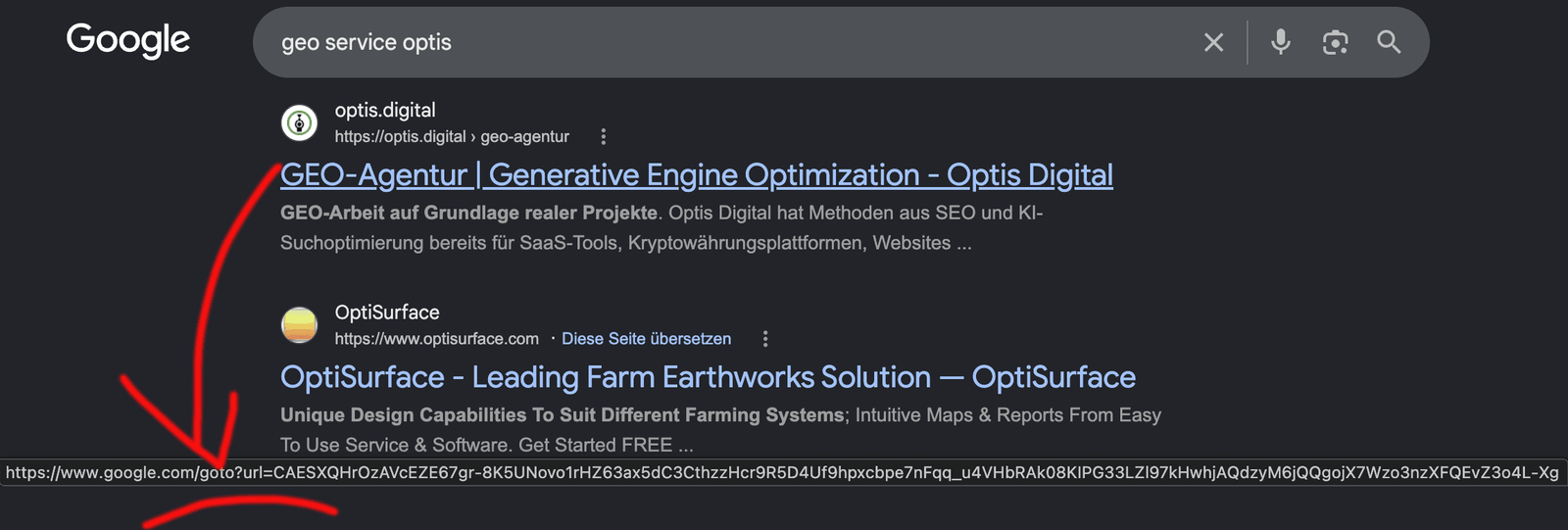
Before this change, the link behind a standard organic result would often point straight to the website. Now, across many search results, the underlying link looks something like this:
A person clicks the result, the request goes to a Google server first, and Google sends the browser to the intended page. Most people won’t notice a thing. The title, domain, and page URL still appear in the search snippet. What changed is the address sitting behind the click.
That part matters.
What Google actually confirmed
The first public sighting dates back to June 23, 2026. The test became more visible in July, and on August 26 Google confirmed the google.com/goto rollout to Search Engine Roundtable. A company spokesperson said: “We have a long history of deploying technical measures against evolving forms of abuse, and we regularly take steps to protect our services and users.”
At the time of publication, Google hasn’t released a dedicated article about /goto in Search Central, the GA4 help center, or the Google Ads documentation. We have a short confirmation and one very broad word: “abuse.” Everything beyond that needs an honest label. It’s a technical conclusion, not a promise from Google.
“Nearly every SERP” doesn’t mean every person gets it every time. Google rolls out changes across regions, accounts, browsers, and search features. You may see direct links today, /goto tomorrow, then direct links again after switching accounts. That’s normal during a rollout.
Why Google did this
Google’s short answer is abuse prevention.
The more useful technical answer is that Google is making large-scale collection of its search results more expensive and much more annoying.
Picture a typical rank tracker. It used to request a results page, find ten or a hundred listings, read their addresses, and record the positions. Fast. Cheap. Easy to repeat across millions of searches.
With /goto, the real destination isn’t sitting in the link as readable text. The service has to follow every redirect and ask Google’s server, “Where does this result go?” One extra request means nothing. Hundreds of millions of extra requests change the economics of the entire operation. Google sees those requests and can rate-limit them, demand JavaScript, serve a CAPTCHA, or block a suspicious IP.
That’s the point.
Google hasn’t said it specifically targeted Ahrefs, Semrush, SerpApi, AI search tools, or agency scripts. Still, the mechanism hits systems that collect SERPs at scale. A real person makes one click. A scraper wants to resolve hundreds of links in seconds.
Could /goto give Google another way to track users? Technically, Google receives an intermediate request and can connect it with the surrounding search context. But the company hasn’t announced new data collection, and it hasn’t described click analytics as the reason for this rollout. Headlines claiming “Google can finally see every click” are selling fear. Google already controlled the search page and already counted clicks for Search Console.
What happens to Google Analytics 4
GA4 should continue classifying most of these visits as google / organic.
This is the part that matters most, because the early conversation quickly jumped to an extreme conclusion: the redirect would erase the source and dump organic traffic into Direct. The available evidence doesn’t support that claim.
According to the Google Analytics documentation, the page_referrer parameter uses the browser’s document.referrer value by default. GA4 uses that information when it determines the traffic source. Google Search applies an origin-level referrer policy, so a site normally receives https://www.google.com/, without the full search path or the query.
The /goto redirect also lives on google.com. As far as GA4 is concerned, the source is still Google.
We already have a practical test. Attributer tested clicks through /goto using 10 device and browser combinations: Chrome, Safari, and Firefox on macOS; Chrome, Edge, and Firefox on Windows 11; Safari and Chrome on iPhone; Chrome on Android; plus Samsung Internet. The referrer survived in all 10 tests, and the visits were assigned to Organic Search.
That isn’t a forever guarantee. Google can change the implementation. Browsers and privacy extensions sometimes remove referrer information regardless of /goto. Consent Mode errors, broken GA4 tags, and redirects on your own site haven’t magically disappeared either.
But right now, there’s no reason to expect a mass migration from google / organic to (direct) / (none).
What should you check? Open the Traffic acquisition report in GA4 and compare the latest seven days with the previous equivalent period. Look at Session source / medium, not only the top-level channel. Then compare google / organic, Direct, and your main organic landing pages. If organic traffic drops sharply, Direct rises by roughly the same amount, and Search Console still shows stable clicks, you have a reason to investigate the referrer and your collection setup.
For now, that’s a monitoring scenario. It isn’t a proven /goto effect.
What happens to Google Search Console
Search Console should keep working as it did before.
Google defines a click in its Performance report as a click from a search result to an external page. Google records that action inside Search, before GA4 on your website even has a chance to load. Replacing a direct href with Google’s redirect doesn’t erase the click.
Google hasn’t published a separate guarantee about /goto and Search Console. The product architecture still gives us a strong answer: impressions, positions, CTR, and clicks are collected on the Search side, so the intermediate address shouldn’t break them.
And please don’t try to force GA4 and Search Console to match down to the last visit. They didn’t match before this rollout. Google explains why: Search Console measures activity before someone enters the site, while Analytics records sessions and behavior after the page loads. One person can click twice, leave before the tag fires, reject consent, or return later.
Treat the gap as a sensor, not an accounting scandal.
Will google.com/goto break Google Ads?
The confirmed August rollout applies to links in Google Search results, mainly organic listings and certain SERP features. Google hasn’t announced a new advertising attribution model tied to /goto.
Google Ads has used its own click-measurement system for years. Most campaign types rely on parallel tracking: the customer goes to the final URL while click measurement runs in the background. The Google Ads help page describes that exact route.
For attribution, one question matters more: did the advertising click identifier reach the final landing page? With auto-tagging enabled, Google adds a GCLID or another supported identifier. The GA4 documentation explains how GCLID connects a visit with campaign, ad group, keyword, and query data. Google Ads also warns that when your site or a third-party click tracker uses redirects, the GCLID must survive all the way to the landing page.
That’s where businesses lose data. The failure usually sits inside their own stack: a WordPress plugin, a link shortener, a CDN rule, an HTTP-to-HTTPS hop, or a badly configured cross-domain checkout.
So don’t turn off auto-tagging. Don’t add UTM parameters to your organic Google listings. Don’t rewrite final URLs because /goto made you nervous.
Use the built-in landing-page test in Google Ads, open Tag Assistant, and confirm that the click identifier remains intact after every redirect on your site. Don’t test this by clicking your own live ad. You’ll pay for the click and dirty your own data.
If the GCLID reaches the final page and your tags fire correctly, /goto alone gives you no reason to change campaigns, bidding, or conversion goals.
Who will feel the update first?
A business owner who checks traffic once a week may never notice.
SEO platforms will.
The exposed group includes rank trackers, SERP APIs, browser extensions that export results, internal agency scripts, share-of-voice tools, and systems that extract citations from AI Overviews. If a program reads the href and treats it as the destination, it may suddenly report hundreds of links to google.com instead of the websites that actually rank.
Then domain matching breaks. Position history becomes unreliable. Competitor reports go sideways. DemandSphere has already described this problem and says it deployed support for the new links. Other vendors will adapt too, but data collection may become more expensive, updates may run less often, and deeper result sets could move into higher-priced plans.
If your rank tracker reported that half your competitors vanished on August 27, don’t celebrate yet. First ask the provider whether it can resolve /goto.
Does the redirect affect SEO or link equity?
There’s no evidence that it does.
Google hasn’t turned an organic result into a normal backlink through its own domain. SERP links weren’t the kind of links used to build PageRank before this change. The /goto redirect operates when a person clicks, while crawling, indexing, and ranking happen in other systems.
You don’t need to change your canonical tags, sitemap, robots.txt file, or internal links. Don’t block google.com/goto in your analytics filters based on a guess. Don’t search for it in Search Console as though it were one of your pages. It belongs to Google.
And please don’t buy “Google redirect protection” from someone who discovered this URL on LinkedIn yesterday.
What to do over the next two weeks
First, save a baseline. Export GA4 and Search Console data for the two weeks before August 26, 2026. Keep GSC clicks, google / organic sessions, Direct traffic, key events, and your main landing pages.
Second, inspect the real referrer. Open an organic result in an incognito window and check document.referrer in the browser or the Referer header in your server logs. Don’t draw a conclusion from one device. Use Chrome on desktop, Safari on an iPhone, another browser your customers actually use, and repeat the check a few days later.
Third, test paid attribution with the tools inside Google Ads and Tag Assistant. Auto-tagging should be enabled, and GCLID must survive every redirect you control.
Fourth, ask your rank-tracking provider whether it supports google.com/goto. You need a direct answer and a deployment date. “We’re monitoring the situation” doesn’t fix your report.
Fifth, set a simple control. If GSC clicks hold steady while GA4 organic sessions fall and Direct rises, inspect data collection. If GSC and GA4 look stable but rankings collapse inside one platform, inspect the platform. If clicks, impressions, and actual leads all fall together, you have an SEO problem; /goto may simply share the same date.
Sixth, don’t break anything early.
This may be the hardest part. SEO people love fixing whatever showed up in their X feed that morning. Two weeks later, they learn Google was running a test, one vendor parsed the URL incorrectly, and the team has already rewritten tracking templates across 40 campaigns.
Don’t do that.
What happens next
Platforms will learn to follow the new redirect. Google will tighten its controls. Platforms will find another route. This race has been running for years; now it’s happening inside every search-result link.
The takeaway for businesses is calm and practical: watch your measurement, then keep doing solid SEO. Useful pages still need to get indexed. Your brand still has to earn trust. Results still come down to leads, revenue, and customers who come back, not a pretty line inside one rank tracker.
The thesis is simple. Google closed another convenient door to its data; your website didn’t disappear.
Check the facts. Keep your own history. Don’t hand the entire truth to one report.
With years of experience navigating the ever-evolving crypto landscape, Eugen knows exactly how to make content shine in Google’s eyes—without breaking the algorithm. With experience working as an SEO specialist in real fast-growing crypto companies, along with training in crypto trading, Google Ads Search Certification, and Google Analytics Individual Qualification, he is a master of SEO in the crypto world, blending AI-powered strategies with deep industry knowledge. From ChatGPT to blockchain trends, he knows how to make content rank, engage, and convert.