n8n marketing automation is no longer something only large companies can afford. With flexible workflow automation, solo founders, agencies, and in-house teams can build custom systems that create content, publish it, and support distribution at scale.
In this guide, you’ll learn what n8n marketing automation means, review practical n8n marketing automation examples, and see how to use n8n for marketing automation based on a real workflow setup for automated video publishing and early growth signals.
n8n marketing automation means using n8n workflows to automate repetitive or complex marketing tasks. Instead of handling everything manually, you connect apps, APIs, and data sources into a system that can run marketing actions automatically.
These actions often include:
content generation
social media scheduling
video publishing
analytics collection
lead handling
SEO content operations
campaign execution
What makes n8n different is its flexibility. Rather than forcing you into a predefined SaaS logic, n8n gives you control over every step of the process. You can build automations that match your own growth strategy, content model, and channel mix.
Why Marketers Use n8n Instead of Traditional Automation Tools
Many marketers start with simple automation tools, but they quickly hit limitations. Traditional platforms are convenient for basic tasks, yet they often become expensive, rigid, or too shallow for advanced workflows.
n8n solves that by offering a more customizable environment.
1. API-Level Flexibility
You can connect with social platforms, CRMs, spreadsheets, CMS systems, AI tools, databases, and custom endpoints. This makes n8n useful not only for standard marketing automation, but also for niche and advanced use cases.
2. Better Control Over Logic
Instead of relying on fixed triggers and limited rules, you can create detailed decision trees, filters, scoring systems, and routing logic tailored to your exact campaign goals.
3. Cost Efficiency at Scale
When content operations grow, many SaaS tools become expensive. n8n can be a more cost-effective option, especially for agencies, growth teams, and technical founders running many workflows.
4. AI + Automation in One Place
n8n works especially well when you combine marketing automation with AI-driven tasks such as script generation, content drafting, metadata creation, and performance categorization.
How to Use n8n for Marketing Automation
If you are asking how to use n8n for marketing automation, the best starting point is not the tool itself but the marketing objective.
Step 1: Define the Goal
Every workflow should begin with a clear business goal. For example:
increase social media reach
publish content faster
reduce manual campaign management
improve early engagement on videos
build an SEO content pipeline
Step 2: Map the Process
Break the manual process into stages. A typical marketing automation flow may include:
data input
content creation
approval or validation
publishing
engagement tracking
reporting or optimization
Step 3: Connect the Tools
In n8n, you can connect your spreadsheet, CMS, media generation tools, social publishing endpoints, and tracking sources. The workflow becomes the operating layer between them.
Step 4: Add Conditions and Timing
Marketing automation is most useful when it behaves intelligently. That means adding rules such as:
publish only at a certain time
skip incomplete content
apply different logic by platform
pull targets from a campaign plan
send alerts if performance is below threshold
Step 5: Measure and Improve
A good marketing automation system is not static. It should collect signals, compare outcomes, and help you improve the next campaign automatically or semi-automatically.
n8n Marketing Automation Examples
Below are several practical n8n marketing automation examples that show how flexible the platform can be.
Example 1: SEO Blog Publishing Workflow
A content team stores topics and keywords in a spreadsheet. n8n pulls the next topic, sends it to an AI model for draft creation, generates metadata, formats the post, and publishes it to WordPress. After publishing, another step can request indexing or update the content tracker.
Example 2: Lead Intake and CRM Routing
When a new lead comes in through a form, the workflow sends the data to a CRM, scores the lead, tags it by interest, and assigns it to the right sales or marketing sequence.
Example 3: Social Media Content Scheduling
A spreadsheet or database contains post ideas, media links, captions, and target dates. n8n takes each row, formats it for a specific channel, publishes it, and logs the result for reporting.
Example 4: Video Content Distribution
A workflow generates a short-form video, creates the description and hashtags, and uploads it to the selected platform. This is one of the most practical examples of n8n marketing automation for creators and growth-focused teams.
My Real n8n Workflow for Video Publishing and Growth Signals
Now let’s get into the real setup.
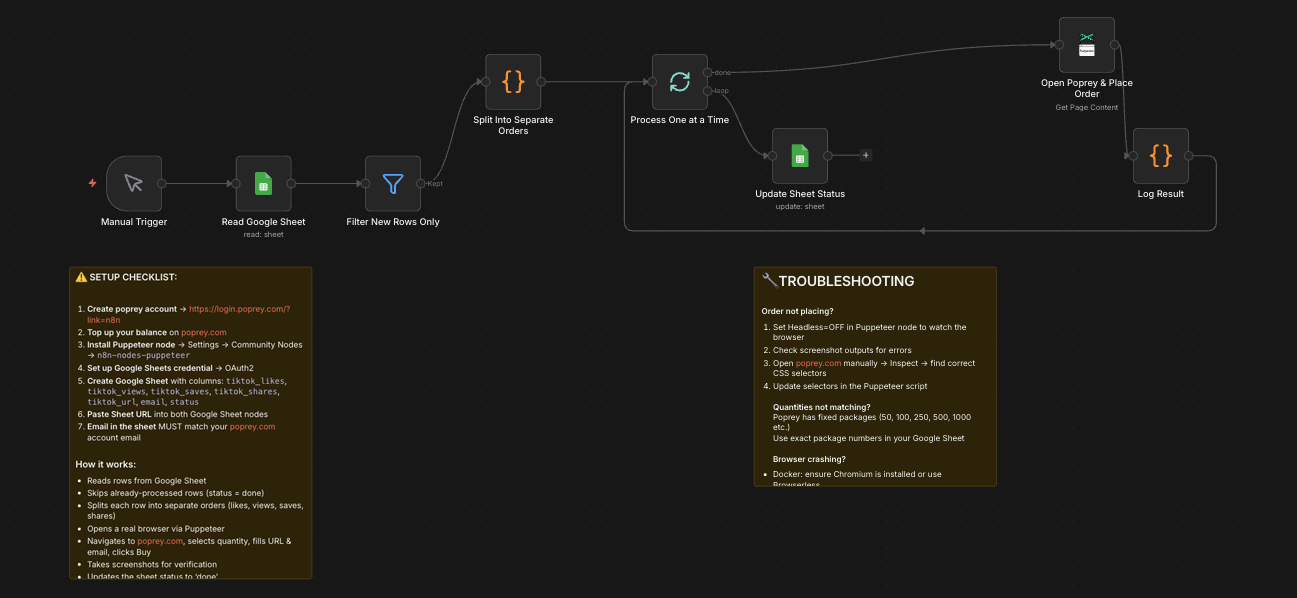
I use a two-part workflow built in n8n to automate short-form video marketing. The main goal is simple: create and upload videos efficiently, then support their early performance according to a predefined marketing plan.
Important note: the real power of n8n is that it lets you turn your own marketing process into a repeatable system. Instead of performing each action manually, you build an operational workflow once and then improve it over time.
Workflow 1: Video Creation and Upload
The first workflow is responsible for producing and publishing the content itself.
1. Topic selection
The workflow starts by reading the next content item from a marketing plan. This can be stored in Google Sheets, Airtable, Notion, or another source.
2. Script generation
Once the topic is selected, AI generates the script, title, short caption, and hashtags. This keeps content creation fast and consistent.
3. Video assembly
The workflow combines text, visuals, voiceover, subtitles, or templates into a finished short-form video asset.
4. Upload and publishing
After the video is ready, the automation sends it to the target channel. It can also log the publish time, content ID, and metadata back into the campaign tracker.
This workflow saves time, removes repetitive manual tasks, and allows a consistent publishing schedule without bottlenecks.
Workflow 2: Marketing Plan Execution for Early Growth Signals
The second workflow is separate from the publishing flow. Its purpose is to execute a predefined support plan for each published video.
Inside the campaign table, I define the target parameters I want for the initial push. These can include:
target views
target likes
target saves
target shares
The values are entered manually according to the marketing plan. n8n then reads those parameters and launches the supporting actions for that specific video.
I use this as an initial push and as a signal layer for the algorithm. The purpose is to help the content gain early traction and improve the probability of broader distribution.
From a systems perspective, this approach is useful because it turns a marketing idea into a structured repeatable process. Instead of guessing what should happen after publishing, the workflow follows a documented plan.
Why This Workflow Is Useful for Marketing Automation
One of the biggest challenges in content marketing is not creating a single asset. It is building a repeatable operating system that handles creation, publishing, and early promotion with minimal manual effort.
That is exactly where n8n marketing automation examples become practical. A workflow like this helps solve several problems at once:
it shortens the time between idea and publication
it standardizes execution
it reduces missed steps
it supports content consistency
it creates a foundation for testing and optimization
Instead of treating each post or video as a one-off task, you begin treating marketing operations like infrastructure.
Benefits of n8n Marketing Automation for Teams and Creators
Scalability
Once a workflow works, it can be reused across many campaigns. That allows small teams to execute at a level that would otherwise require far more manual labor.
Consistency
Automation helps ensure that every piece of content follows the same operational standards for formatting, scheduling, tagging, and logging.
Speed
Manual operations slow down growth. n8n can compress multiple tasks into one automated chain.
Centralization
Instead of jumping between five or ten tools, you control the logic from one workflow environment.
Better Testing
When workflows are structured, it becomes easier to test variables such as content type, posting schedule, metadata, or support intensity.
Best Practices for Building n8n Marketing Automation Workflows
Start with one use case. Do not automate everything at once.
Keep your campaign plan clean. Structured source data makes the automation more reliable.
Log every action. Save statuses, IDs, timestamps, and outcomes.
Use modular workflows. Separate content creation, publishing, and reporting when possible.
Review results regularly. Automation is more effective when paired with ongoing optimization.
Final Thoughts
If you want to understand how to use n8n for marketing automation, the key idea is simple: treat your marketing process as a system that can be modeled, automated, and improved.
The best n8n marketing automation examples are not generic templates. They are workflows built around real business goals. In my case, that means automating video creation and upload, then executing a separate workflow based on a predefined growth plan for early traction.
This approach turns marketing from a collection of manual tasks into an operational engine. And that is why n8n marketing automation is becoming so valuable for founders, agencies, and technical marketers who want more control, more speed, and a more scalable workflow.
FAQ: n8n Marketing Automation
What is n8n marketing automation?
n8n marketing automation is the use of n8n workflows to automate marketing tasks such as content creation, publishing, reporting, lead handling, and campaign execution.
How do you use n8n for marketing automation?
You start by defining a marketing goal, mapping the process, connecting your tools and data sources, adding workflow logic, and then using n8n to run those tasks automatically.
What are some n8n marketing automation examples?
Examples include blog publishing workflows, social media scheduling, lead routing, AI content pipelines, video creation systems, and analytics reporting workflows.
Is n8n good for content marketing?
Yes. n8n is especially useful for content marketing because it can automate topic management, AI generation, metadata creation, publishing, and performance tracking.
Why do marketers choose n8n?
Marketers choose n8n because it offers flexibility, strong integration options, custom logic, and a scalable way to build workflows tailored to their own strategy.
With years of experience navigating the ever-evolving crypto landscape, Eugen knows exactly how to make content shine in Google’s eyes—without breaking the algorithm. With experience working as an SEO specialist in real fast-growing crypto companies, along with training in crypto trading, Google Ads Search Certification, and Google Analytics Individual Qualification, he is a master of SEO in the crypto world, blending AI-powered strategies with deep industry knowledge. From ChatGPT to blockchain trends, he knows how to make content rank, engage, and convert.